
In this guide
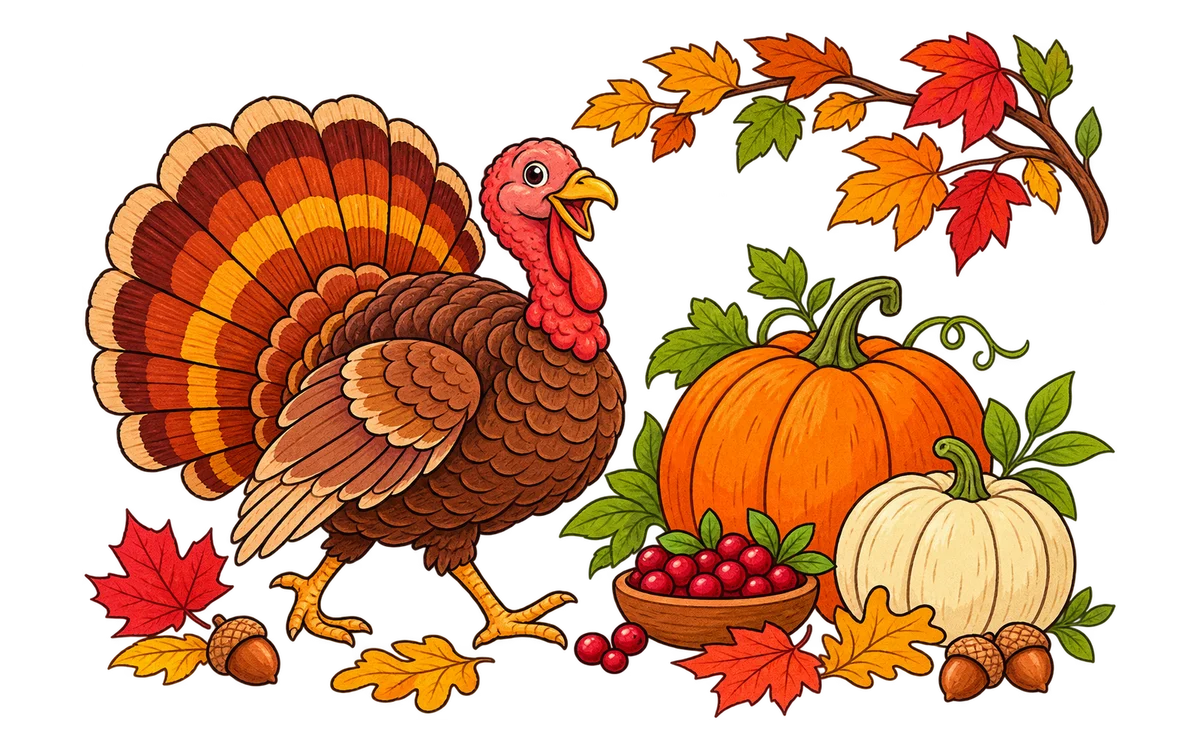

A friendly turkey beside orange and cream pumpkins, cranberries, acorns and bright autumn leaves.
A wild turkey can fly, cranberries have air pockets, and the U.S. holiday follows a weekday rather than the same numbered date each year. These Thanksgiving fun facts come with links to their sources and a free printable activity: ten quiz cards, two conversation prompts and a separate answer key.
The holiday information here concerns Thanksgiving in the United States. The short explanations work for reading together; younger children can start with the bird and cranberry questions, while older readers can explore the linked history. You can read the facts first or go straight to the printable cards.
Ten Thanksgiving facts to share
1. Thanksgiving follows a weekday, rather than a fixed date
U.S. Thanksgiving falls on the fourth Thursday in November. In 2026, that is November 26. Look for the fourth Thursday on a calendar rather than circling the same numbered date every year.
Source: U.S. Office of Personnel Management — Federal holidays.
2. The fourth-Thursday rule was settled in 1941
President Franklin D. Roosevelt signed the congressional resolution on December 26, 1941. Choosing the fourth Thursday also accounts for Novembers that have five Thursdays: fourth and last are not always the same day.
Source: National Archives — Congress Establishes Thanksgiving.
3. An editor campaigned for a shared national celebration
Sarah Josepha Hale, editor of Godey's Lady's Book, advocated for a national Thanksgiving. She wrote to Abraham Lincoln in September 1863; he issued his Thanksgiving proclamation the following month. Her letter is a reminder that a holiday tradition can take years of campaigning.
Source: Library of Congress — The Woman Who Helped Put Thanksgiving on the Calendar.
4. The 1621 harvest celebration lasted three days
The National Museum of the American Indian describes a three-day harvest gathering at Plimoth in 1621, involving English colonists and Wampanoag people, including Ousamequin. That event and the modern federal holiday belong to different points in history.
Source: National Museum of the American Indian — Thanksgiving timeline.
5. Wild turkeys can fly
A wild turkey can take to the air, even though you may be more used to seeing one walking. Keep the word wild in this fact: it identifies the birds described by the zoo's account.
Source: Smithsonian's National Zoo — Turkey.
6. Wild turkeys sleep in trees
Wild turkeys roost on branches at night. A turkey high in a tree is therefore doing something quite ordinary for its species, rather than looking for a nest in a surprising place.
Source: Smithsonian's National Zoo — Turkey.
7. Their menu includes plants and small animals
Wild turkeys are omnivores. Their food includes seeds, nuts and berries, as well as insects and other small animals. Omnivore means an animal that eats both plant and animal food.
Source: Smithsonian's National Zoo — Turkey.
8. A gobble is only one turkey sound
Biologists have identified at least 15 wild-turkey vocalizations, according to the Smithsonian's National Zoo. The familiar male gobble is one of them. A species can communicate with more than the single sound we associate with it.
Source: Smithsonian's National Zoo — Turkey.
9. Air pockets help cranberries float
Cranberries have four internal air pockets. Those spaces help the berries float during a wet harvest, when growers collect the loosened fruit from the water's surface. The floating red berries have a practical explanation.
Source: Massachusetts Cranberries — Frequently Asked Questions.
10. Cranberries do not spend the growing season underwater
The familiar flooded harvest is only part of the picture. Cranberries grow on low vines in beds; growers use water for purposes including irrigation and wet harvesting. A harvest photograph does not show how the crop looks all year.
Source: Massachusetts Cranberries — Frequently Asked Questions.
Put the harvest story in context
Wampanoag history began long before 1621 and continues today. A three-day gathering cannot stand in for the whole story of colonization, land loss and living Native communities. Read the museum's wider timeline and the Mashpee Wampanoag Tribe's own account alongside a holiday quiz.
Explore the museum's wider Wampanoag timeline and the Mashpee Wampanoag Tribe's own website. The harvest story is one part of a much longer history.
When discussing the quiz, keep the 1621 gathering and the modern holiday distinct. The three-day answer describes a particular harvest event; the 1941 answer describes a federal holiday rule. Neither answer explains the whole history by itself.
Print the quiz and conversation cards
The four-page pack contains:
- Pages 1–2: ten numbered quiz cards and two unnumbered conversation cards, six cards on each page.
- Page 3: the ten quiz answers, with a source named beside each answer.
- Page 4: ways to play, historical context and source links for further reading.
PDFs open in a new tab. Both versions have the same four pages: two pages of cards, an answer key, then instructions and sources.
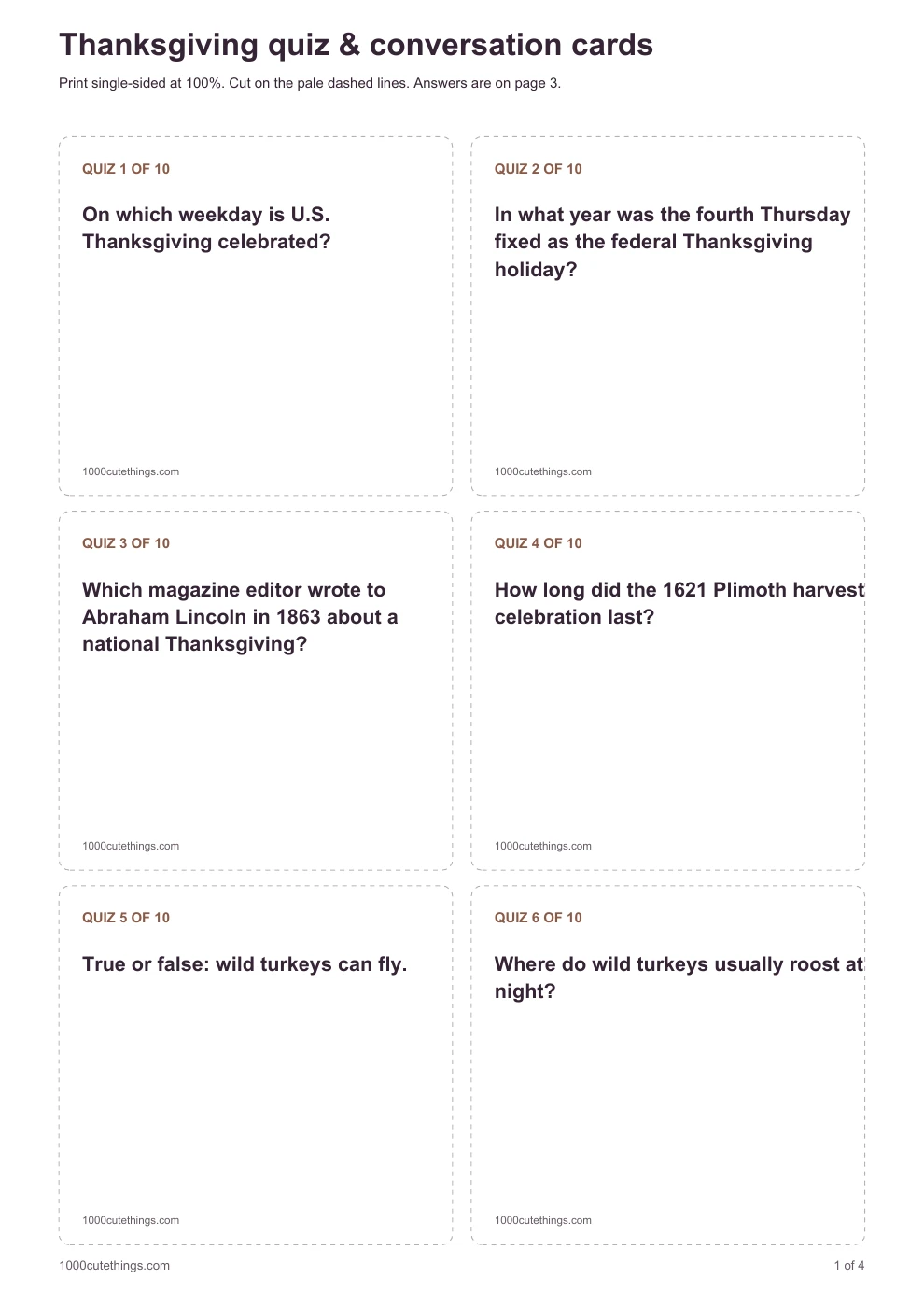
The first six question cards as arranged on page one of the printable pack. Answers are on a separate page.
Choose the file that matches your paper, print single-sided at 100%, and check the preview before printing. Use pages 1–2 for the cards; keep page 3 with the person asking the questions. Cut along the pale dashed outlines. An adult can prepare the cut cards for younger children. Keep page 4 intact for the reading links.
Take turns reading a question aloud. Allow a guess, then check the answer key. You can award one point per correct answer or skip scoring. For younger readers, offer two possible answers or play together as one team. A short round of just the turkey and cranberry cards is enough if you want a small activity.
Try the quiz on screen
Read a question and make a guess before opening its answer. Each answer links back to the fact and source above. These are the same ten questions as the printable cards.
1. On which weekday is U.S. Thanksgiving celebrated?
Thursday: specifically, the fourth Thursday in November. Read the fact and source.
2. In what year was the fourth Thursday fixed as the federal Thanksgiving holiday?
1941. President Roosevelt signed the resolution on December 26. Read the fact and source.
3. Which magazine editor wrote to Abraham Lincoln in 1863 about a national Thanksgiving?
Sarah Josepha Hale, editor of Godey's Lady's Book. Read the fact and source.
4. How long did the 1621 Plimoth harvest celebration last?
Three days. It involved English colonists and Wampanoag people. Read the fact and source.
5. True or false: wild turkeys can fly.
True. Wild turkeys can fly. Read the fact and source.
6. Where do wild turkeys usually roost at night?
In trees, on branches. Read the fact and source.
7. Are wild turkeys herbivores or omnivores?
Omnivores: they eat both plant and animal food. Read the fact and source.
8. Is a gobble the only sound wild turkeys make?
No. Biologists have identified at least 15 vocalizations. Read the fact and source.
9. What inside a cranberry helps it float?
Four air pockets inside the berry. Read the fact and source.
10. True or false: cranberries grow underwater all year.
False. They grow on low vines in beds; water is used for wet harvesting and other purposes. Read the fact and source.
Make room for a conversation
The final two cards invite a conversation rather than a correct answer:
- Name one small thing someone did for you this week. What made it helpful?
- Choose one tradition you would like to keep, change or start. What would you choose and why?
Let anyone pass, or answer with a small everyday example. A helpful moment or a tradition someone would like to change can be easier to discuss than a large, personal question.
If someone would rather make something while listening, offer one of the six Thanksgiving coloring pages. The turkey, pumpkin, leaves, pie, cranberries and basket can be printed separately, so the activity need not turn into a full pack for every person.
Read the sources
The facts and card answers were checked against these sources on 4 November 2026. The 2026 holiday date is stated for that year; the fourth-Thursday rule explains how to find it in other years.
- U.S. Office of Personnel Management — Federal holidays
- National Archives — Congress Establishes Thanksgiving
- Library of Congress — The Woman Who Helped Put Thanksgiving on the Calendar
- National Museum of the American Indian — Thanksgiving timeline
- Smithsonian's National Zoo — Turkey
- Massachusetts Cranberries — Frequently Asked Questions
For a longer conversation about history, follow the museum and Wampanoag community links in the context section as well. The cards are a starting activity, with the sources there when a question deserves more than a short answer.