Inside this story
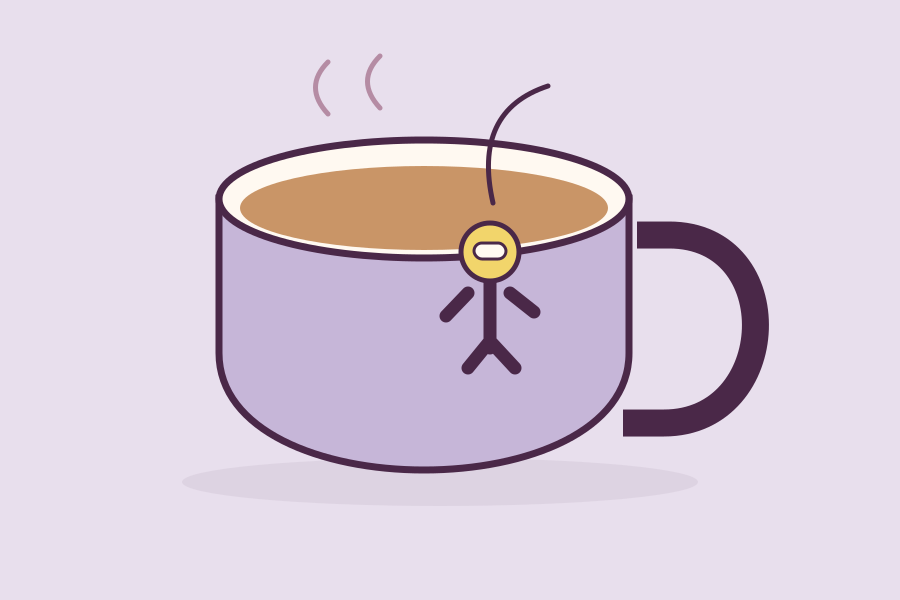
A mug of tea supplies almost everything a tiny underwater scene needs: water, a rim and a sense of depth. Give the infuser a diver’s silhouette and lowering it into the cup becomes part of the joke.
There is a documented product story behind that idea. Tea Diver was created by Seoul design studio Abel Partners. Looking at its origin makes the object more interesting than a generic cute accessory—and gives us a useful way to judge other playful infusers.
Meet the real Tea Diver design
In a 2012 interview published by Designmap, Abel Partners discusses Tea Diver and its companion tea accessory, Tea Fishing. The designers describe inspiration from a documentary about traditional Korean divers working underwater with an air hose. That connection gives the tea object a more specific starting point than a cartoon scuba character.
The interview also distinguishes the functions: Tea Diver is an infuser for loose tea, while Tea Fishing is a holder for a tea bag. They share a world of water and small figures, but they do different jobs.
Visit the original interview to see the studio’s product photographs. The useful design relationship is the action: the diver enters the water as the tea is immersed. The cup becomes part of the scene rather than just a background for a decorative object.
Compare the ways an infuser can tell a story
An accessory can build its idea through its character, its movement or the setting already supplied by the mug.
Swipe across the table to see all three columns.
| Example | The visual idea | A useful comparison question |
|---|---|---|
| Abel Partners’ Tea Diver | A small diver entering the cup | How does the brewing action contribute to the scene? |
| OTOTO’s Tea Sub | A submarine-shaped infuser | How is it lowered, retrieved and rested after use? |
| Kikkerland’s guitar infuser | A familiar instrument translated into a tea accessory | Does the silhouette remain clear while accommodating the tea? |
OTOTO’s product page describes Tea Sub as a loose-leaf infuser with a chain; Kikkerland identifies its guitar design as stainless steel. Use each maker’s own images and instructions for the actual product details. Different objects can share a playful mood without sharing materials, dimensions or care requirements.
A historical design article does not establish current availability. Check a maker or seller’s current listing before treating an older example as something you can order.
Check the practical details before choosing
Start with the cup and tea you already use. A design that looks comfortable in a tall glass may sit awkwardly in a shallow mug.
Fit: compare the stated dimensions with the mug’s opening and depth. Check whether the object hangs, sits on the rim or rests inside the cup.
Leaf space: look at the usable chamber, not only the outside shape. Consider the tea’s leaf size and the maker’s intended use. A decorative outline does not tell you how much space remains inside.
Openings: compare the holes or mesh with the tea you plan to use. Very fine particles and larger leaves ask different things of a filter. Follow the product and tea instructions rather than assuming one design suits every blend.
Cleaning: examine where the pieces separate and how leaves can be removed. Tiny enclosed corners deserve attention before purchase. Check the stated cleaning method instead of inferring dishwasher suitability from the material alone.
Retrieval and resting: picture lifting the infuser out and putting it down. A useful drip dish is part of the everyday experience, even when it is less photogenic than the character.
Use these questions to build a shortlist, then return to each maker’s current instructions for the details that matter to your cup and tea.
Give the tea ritual a useful home
Once the accessory suits the cup, decide how much of a setting it needs. The room studies below use an ordinary mesh infuser to focus on placement: a window tray, a clear desk corner and a small gift arrangement.
Swipe to explore, or choose an example below.
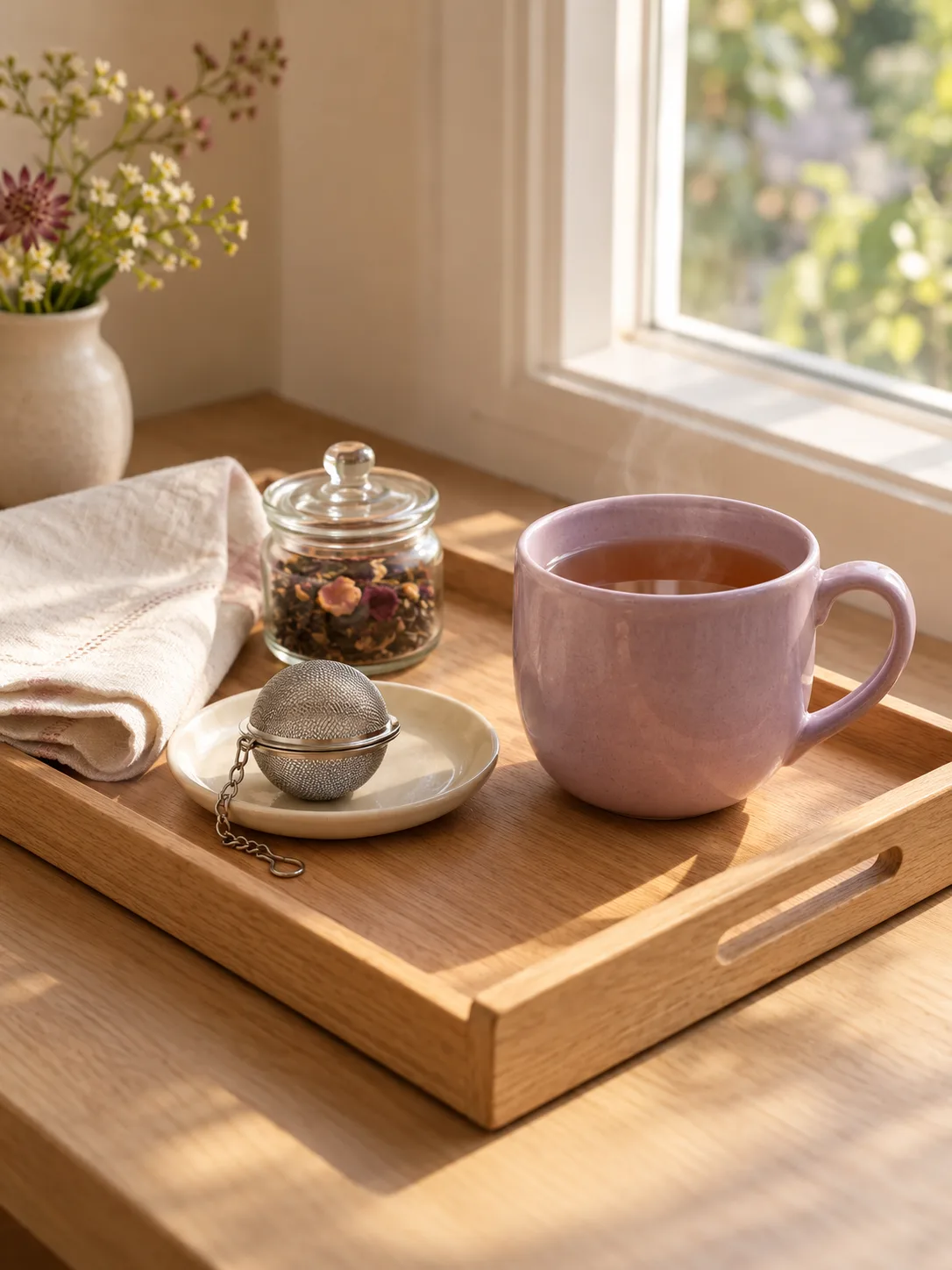

The window-side pause
Keep the mug, tea and infuser rest together on one small tray. A clear resting place makes the little ritual easier to repeat.
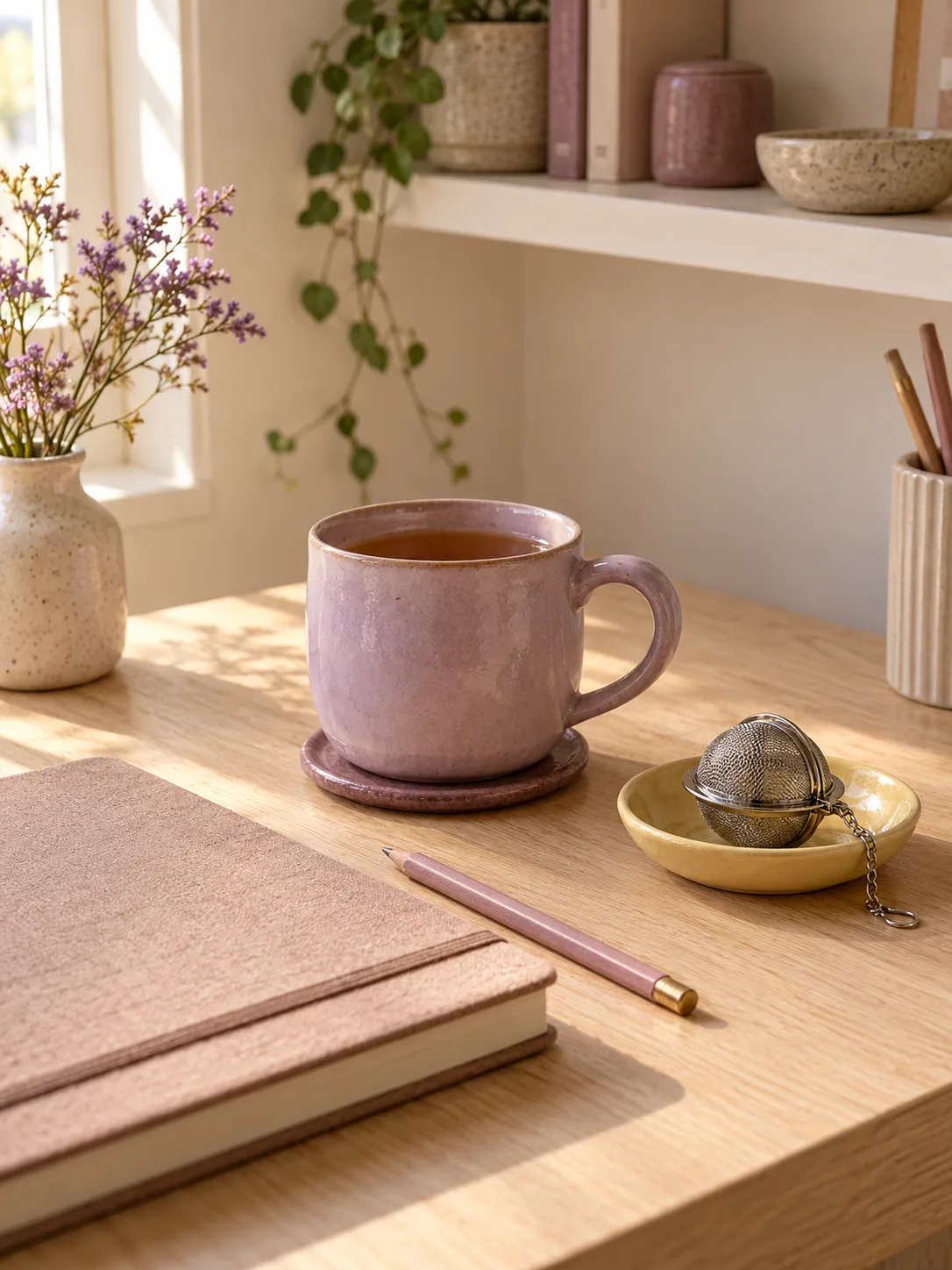
A corner of the desk
Give the used infuser its own little dish and leave a comfortable space between the tea and your work. A single color accent is enough.
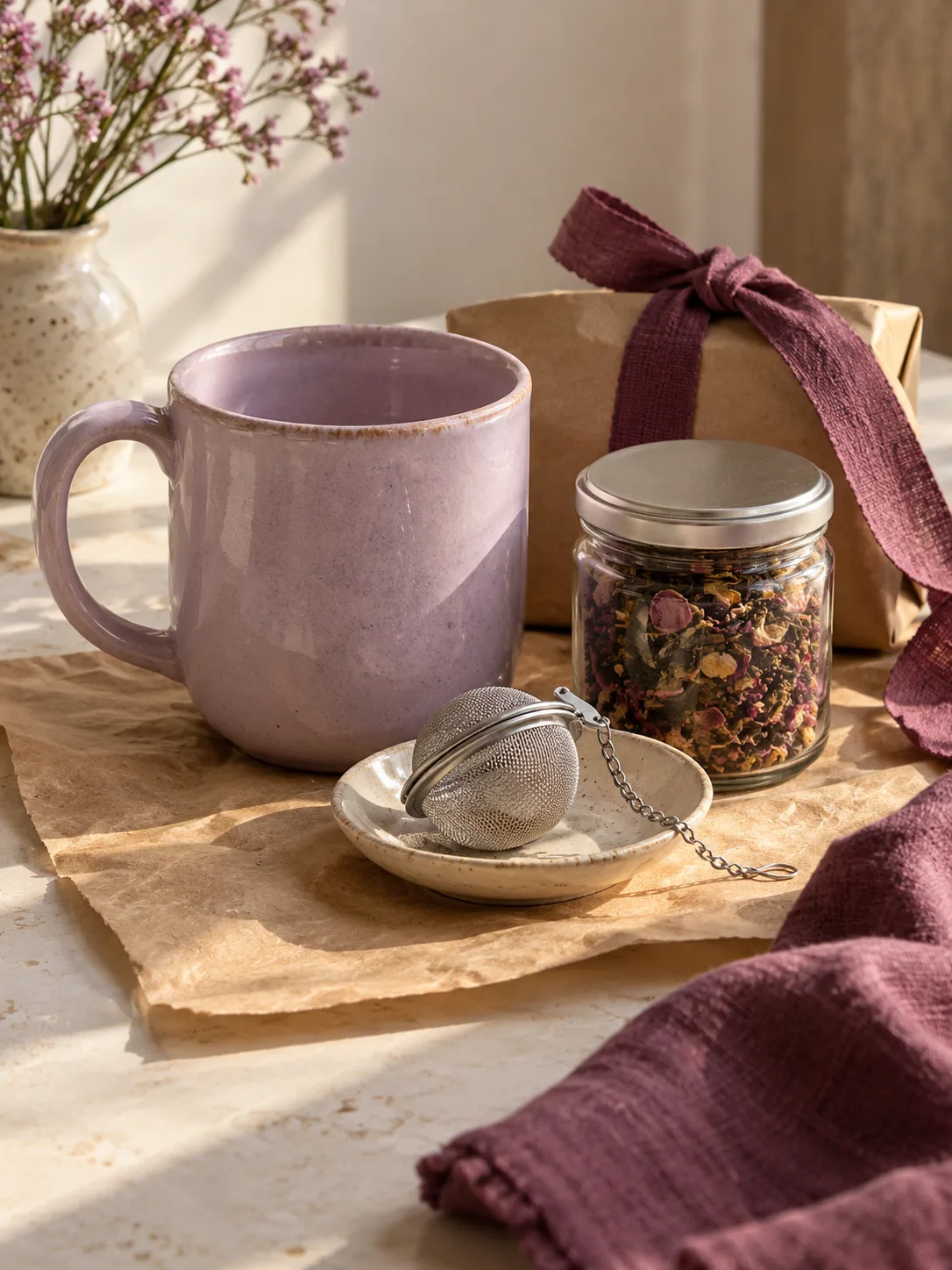
A thoughtful small gift
Bring the useful pieces together: mug, tea, infuser and a place to put it down. Simple paper and a little ribbon keep the gesture personal.
For a window tray, keep the mug and infuser rest within reach and carry it only when it can be handled comfortably. At a desk, give the drink a stable place away from papers and equipment. For a gift, choose the mug, tea and accessory together so the recipient has a useful set of pieces.
Color can come from what you own: a favorite mug, a small dish or a folded napkin. The setting does not need to become a matching collection. Leave enough clear space to make and put away the drink easily.
That is what makes a small novelty worth living with: the idea adds pleasure to an ordinary action while the object still earns its place in the routine.