
In this story
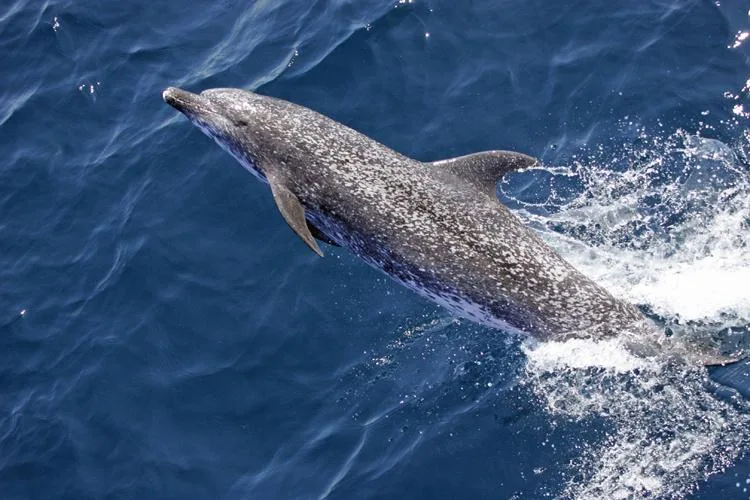
An Atlantic spotted dolphin at the surface, showing the dense pattern that gives the species its name. Photo: NOAA Fisheries · Public domain (US). Resized.
A few dolphins turn toward one another, and the scene is easy to read as a conversation. What could they be saying? Are they keeping in touch, finding food, or reacting to the animal beside them?
Atlantic spotted dolphins use whistles, echolocation clicks and rapid bursts of sound. Those sounds do different jobs, and researchers study them alongside the dolphins’ movements and relationships. The result is more interesting than an imagined exchange of human words: a glimpse of how another social animal experiences its world.
Here is a closer look at these “chatty” dolphins, followed by a short listening and watching activity you can try from home.
Meet the Atlantic spotted dolphin
The Atlantic spotted dolphin, Stenella frontalis, lives in warm temperate and tropical Atlantic waters, including the Bahamas. Adults reach roughly 5 to 7.5 feet in length. Their bodies have a curved dorsal fin, a pronounced beak and a pattern that changes as they grow.
The surprising detail is that young Atlantic spotted dolphins begin life without spots. Spotting develops with age, so a lightly marked youngster and a densely patterned adult can look quite different. Location also influences their appearance; the name alone is not a complete identification guide.
These dolphins live in groups and sometimes associate with bottlenose dolphins. They eat small fish and other marine prey, including squid, and may search for hidden fish in the sandy bottom. The NOAA Fisheries species profile is a useful starting point for their identification and natural history.


Atlantic spotted dolphins photographed off Long Cay, near South Caicos in the Turks and Caicos Islands. The photograph captures their positions, while the sounds and sequence of events remain outside the frame. Photo: Bmatulis · CC BY 3.0. Resized.
Whistles, clicks and bursts of sound
The Wild Dolphin Project’s communication guide groups dolphin sounds into three broad types. Its researchers have followed spotted and bottlenose dolphins in the Bahamas since 1985, recording underwater behavior as well as sound.
| Sound | What it is useful for | What to listen for in a recording |
|---|---|---|
| Whistles | Social contact, including contact between separated mothers and calves | A tone that rises, falls or changes shape |
| Echolocation clicks | Gathering information about surroundings and potential prey | Short, repeated pulses; much of the acoustic information is above human hearing |
| Burst-pulsed sounds | Close social interactions, including some conflicts | Clicks packed tightly together, producing a buzzing or squawking quality |
This is an introduction to sound types, not a dictionary of dolphin sentences. A recording’s context matters: who is present, what they are doing, and what changes before or after a sound.
The project also describes individually distinctive signature whistles used in social contact. That gives researchers another way to investigate relationships, alongside recognizing dolphins from their markings and fins.
To hear the contrast, use the whistle, click and burst-pulse examples on the researchers’ communication page. Listen at a comfortable volume; a recording gives us only the sounds captured and reproduced by its equipment.
A photograph starts the question
The underwater photograph above invites a story. Several dolphins share the frame, their bodies turned at different angles. We can describe those positions directly. We would need a sequence of observations to establish what led to them, and an acoustic recording to investigate any accompanying sounds.
Even with video and sound together, identifying the caller can be difficult. The dolphin nearest the camera need not be the source of the sound we hear.
In a 2016 study of acoustic localization, researchers combined underwater video with recordings from multiple hydrophones—underwater microphones. Differences in when a sound reached the microphones helped estimate its source and place that information on the video. The method had limitations, including difficulties with some quieter whistles and reflected sound.
This extra step makes a small scene much richer. Researchers can ask which individual produced a signal and what happened around it, rather than assigning every sound to the most visible dolphin.
Try a short watch and listen
The Wild Dolphin Project’s dolphin video page includes a short 2014 film of spotted dolphins in the Bahamas. Its accompanying account identifies adults and mother–calf pairs, including a mother and calf making a synchronized dive.
Choose the clip titled “The Wild Dolphin Project: Spotted Dolphins in the Bahamas GoPro Hero3” and try this short sequence:
- Watch the movement first. Follow one dolphin for a few seconds. Notice which animal stays nearby, whether their directions match, and when the pair turns or leaves the frame.
- Listen to a sound example. Open the project’s communication guide and compare its whistle and click recordings. These are separate examples, not an identified soundtrack for the dolphins in the film.
- Write one observation and one question. For example: “Two dolphins dived together.” Then: “Did either produce a sound before the dive?”
Read the researchers’ account after your first watch. Their identification work adds context that a brief viewing cannot supply. You can enjoy the encounter while leaving an unanswered question open.
Can dolphins learn our sounds?
Research on sound learning offers a particularly interesting answer. A 2024 study by Herzing and colleagues examined wild Atlantic spotted dolphins exposed to computer-generated sounds during sessions with an underwater communication interface.
The researchers reported immediate and delayed vocal imitation, including attempts to copy features of the sounds. They did not find evidence that the dolphins functionally understood the object labels used in the experiment.
That distinction helps us appreciate the finding accurately. Copying a new sound shows vocal flexibility; demonstrating that a sound consistently stands for an object asks a further question. The study provides evidence for the first without establishing the second.
For the same reason, a compelling headline about “talking with dolphins” deserves a closer read. Look for the species studied, the task the animals performed, and the authors’ actual conclusion. A spotted-dolphin finding and a bottlenose-dolphin finding each belong to their own study.
Leave room for a wild life
The appeal of a close photograph is understandable. A dolphin’s life, however, includes feeding, resting, caring for young and choosing its companions. A good encounter leaves room for those activities to continue.
NOAA’s marine life viewing guidance advises observing dolphins from a distance and avoiding feeding, touching, chasing or attempts to swim with them. Check the current guidance for the place and species involved before a visit; research footage is not an invitation to recreate a researcher’s encounter.
There is plenty to notice from home, too. Revisit a recording, compare the positions in a photograph, or choose an ocean animal from our coloring pages. For a small observation exercise, add two notes beside your picture: one thing the research shows and one thing you still wonder about.
The pleasure of watching these animals grows with attention. A whistle has a shape, a familiar companion stays close, and a coordinated turn opens another question. “Chatty dolphins” is a lovely place to begin looking and listening.